
'I Never Want It to End': The Surprise Economic Boost for World Cup Host Cities-By Owen Tucker-Smith,WSJ



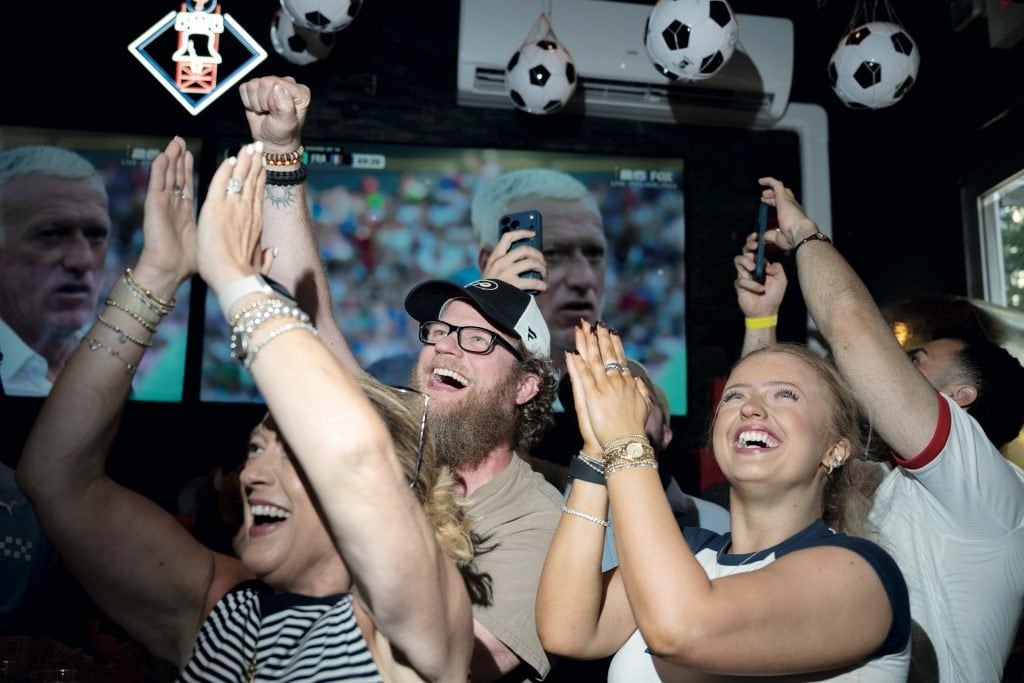
The Scots drank every drop of beer in Boston. The Dutch filled Kansas City’s hotels. The French chowed down on Philly cheesesteaks.
For the past month, soccer fans at home and from abroad opened their wallets and boosted spending in World Cup host cities across the U.S. The complete tally is still being added up (the final match was Sunday, but some American business owners are already claiming economic victory. The biggest winners weren’t star-studded cities such as New York and Los Angeles, but less-obvious destinations including Philadelphia and Kansas City, Mo., which saw significant boosts in tourism.
“It’s fun to make a lot of money,” said Doug Hager, owner of Brauhaus Schmitz, a German beer hall and restaurant in Philadelphia that anointed itself the city’s “World Cup Headquarters” and advertised “late afternoon matches that absolutely ruin your productivity.” Hager has sold roughly 4,000 German pretzels since the tournament began.
A few months ago, some hospitality-industry experts feared that the World Cup was gearing up to be a bust for the American economy. There was concern, said Victor Matheson , an economics professor at the College of the Holy Cross, that the crowds and distraction of the World Cup would keep traditional tourists from visiting host cities—and that the soccer fans wouldn’t come either.
Mark Prinzinger , co-owner of a sports bar in Philadelphia, made extensive preparations for the tournament. He hung a 20-foot map of the world and readied a soon-to-be bestselling cocktail dubbed the Mbappé Motherf—, a reference to the French soccer star Kylian Mbappé . But Prinzinger was worried in the days leading up to the tournament that nobody would come.
Instead, the tournament has helped lift domestic consumer spending in such cities as Philadelphia, according to Bank of America data. At Prinzinger’s bar, fans came in Super Bowl numbers every day. He maxed out the number of bartenders he could squeeze behind the counter. “We’re running out of everything that you can imagine, on a daily basis,” he said.
“The soccer fans did show up,” said Matheson.
It couldn’t immediately be determined whether the tournament really was the $17 billion gross domestic product boost that FIFA said it would be.
Bank of America estimates that credit- and debit-card spending by Americans rose 6.3% in June from a year earlier, the strongest growth rate in more than four years. That increase was likely lifted by the World Cup, the bank’s economists wrote. The event lifted spending especially at restaurants but also at bricks-and-mortar retail stores, Bank of America economists said.
Bank of America is a sponsor of the World Cup. Its data excludes spending by foreign travelers, so the total economic impact of World Cup-related tourism isn’t yet clear.
Philadelphia, Kansas City, Dallas and Houston all enjoyed a modest boost in advance flight bookings from Europe during the tournament, according to estimates from the aviation company Cirium. Meanwhile, Los Angeles, Miami and New York saw drops in advance flight bookings.
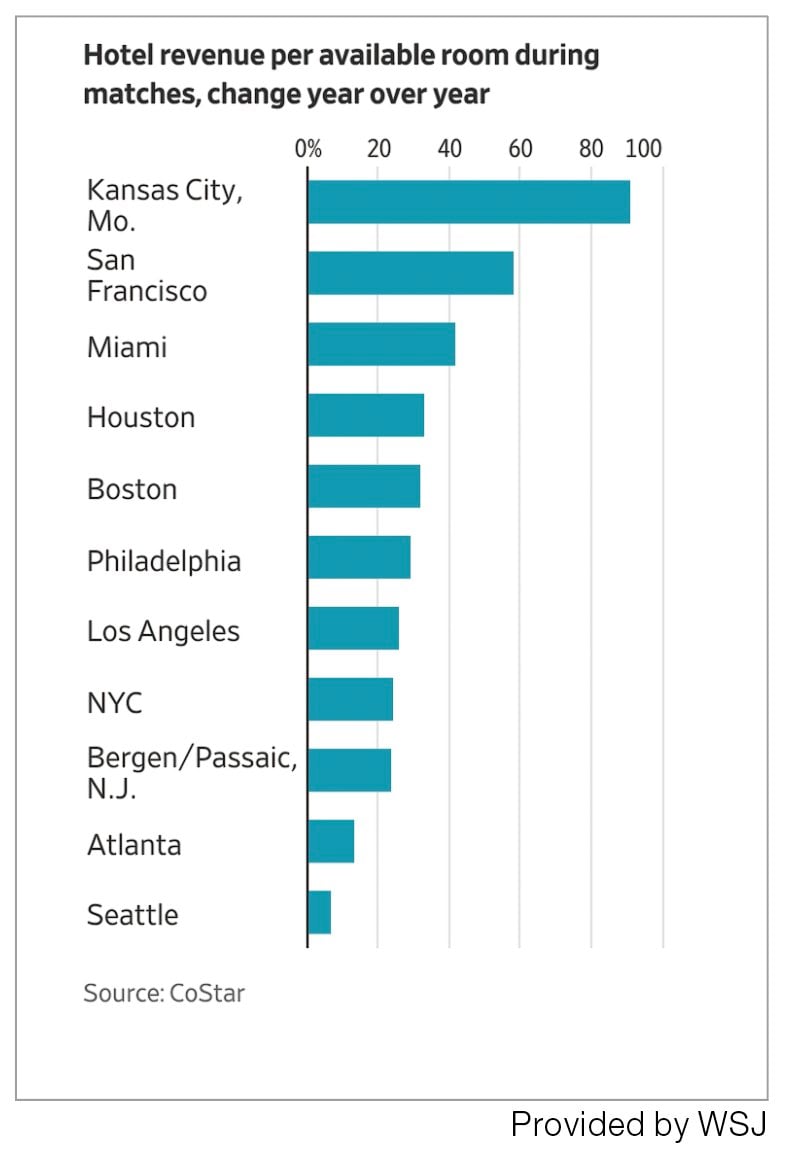
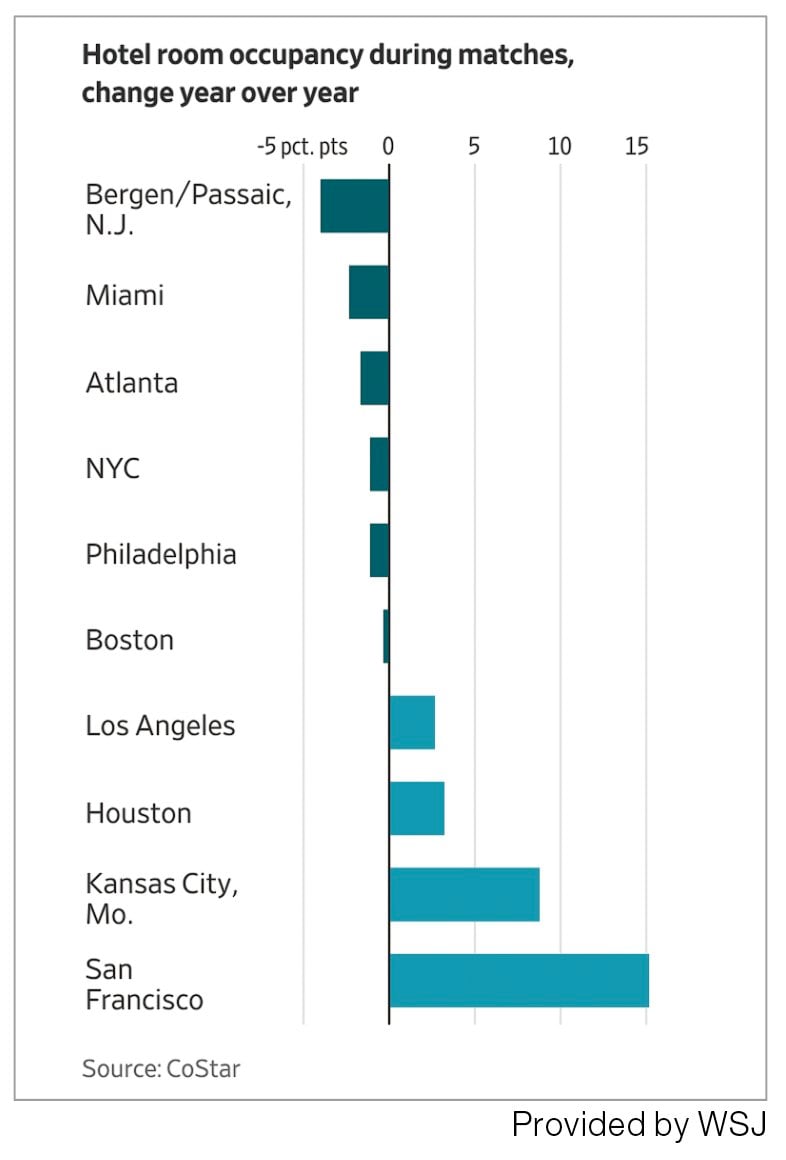
Hotels have been big winners, in large part because they were able to charge much higher prices than usual. Host-city hotels squeezed roughly 35% more revenue out of available rooms during the average match day through early July than they did a year earlier, according to an analysis of CoStar data. Occupancy-rate increases were lukewarm during the group stage, but accelerated in the round of 32 and again during the round of 16. Overall, rates picked up in some locations, but ticked down in others. In some instances, hotels made up for the shortfalls by hiking room rates.
FIFA estimated before the tournament that the World Cup would generate roughly 185,000 full-time jobs in the U.S. But hiring related to the event hasn’t had a notable effect on the economy. The Labor Department reported a significant loss of jobs in leisure and hospitality in June.
A body of economic research argues that megaevents such as the World Cup and the Olympics don’t actually benefit host cities, which spend millions of dollars on infrastructure but lose out on traditional tourists who would visit during an ordinary summer but are intimidated by the crowds. For the broader U.S. economy, such events are often a wash, said Matheson: A tourist who might otherwise visit Denver for the summer visits Kansas City to watch soccer matches instead.
“The World Cup is making us happy,” he said. “There’s not a lot of evidence it’s making us rich.”
Overall spending in Philadelphia, though, is up from last year, according to the Bank of America data. Plus, the city’s infrastructure managed to withstand the impact of a World Cup as well as the city’s America 250 celebration this month. “That was a solid win,” said Saloni Tandon of the Economy League of Greater Philadelphia.
In Phoenixville, Pa., a suburb northwest of Philadelphia, Soko Bag, a Korean fried-chicken and sports bar, was midway through showing the England-Norway match when a rainstorm hit. Water was splashing against the windows, said co-owner Shea Roggio , and his electricity shut down.
The bar was packed with fans at the time, and he was on track for a record sales day. He started to panic. “It was the worst 10 minutes of my life,” he said.
Yet despite the lack of power, spotty internet and a toilet that broke down, Roggio was relieved to have a bar full of Norwegian and British fans gathered in his Pennsylvania establishment eating Korean fried chicken. The power returned, and he grossed around $13,000 that day. “I never want it to end,” he said.
免責聲明:本專頁刊載的所有投資分析技巧,只可作參考用途。市場瞬息萬變,讀者在作出投資決定前理應審慎,並主動掌握市場最新狀況。若不幸招致任何損失,概與本刊及相關作者無關。而本集團旗下網站或社交平台的網誌內容及觀點,僅屬筆者個人意見,與新傳媒立場無關。本集團旗下網站對因上述人士張貼之資訊內容所帶來之損失或損害概不負責。