

Bessent Says the U.S. Can Grow Its Way Out of the Debt Crunch. What Would It Take?-By Richard Rubin and Justin Lahart,WSJ



The U.S. debt picture looks bleak. Is there a way out of the coming crunch?
One path requires tough trade-offs lawmakers have ducked for decades: higher taxes and lower spending. Another route sounds more appealing: growth. Even if the country owes trillions more dollars, additional debt will matter less if the economy booms even faster.
That is the tale Treasury Secretary Scott Bessent and administration officials have touted as the U.S. crossed borrowing milestones , with publicly held debt hitting 100% of gross domestic product and gross debt topping $40 trillion. Bessent sketched a scenario where the government benefits from growth fueled by the artificial-intelligence build-out, reshored manufacturing and tax cuts for consumers.
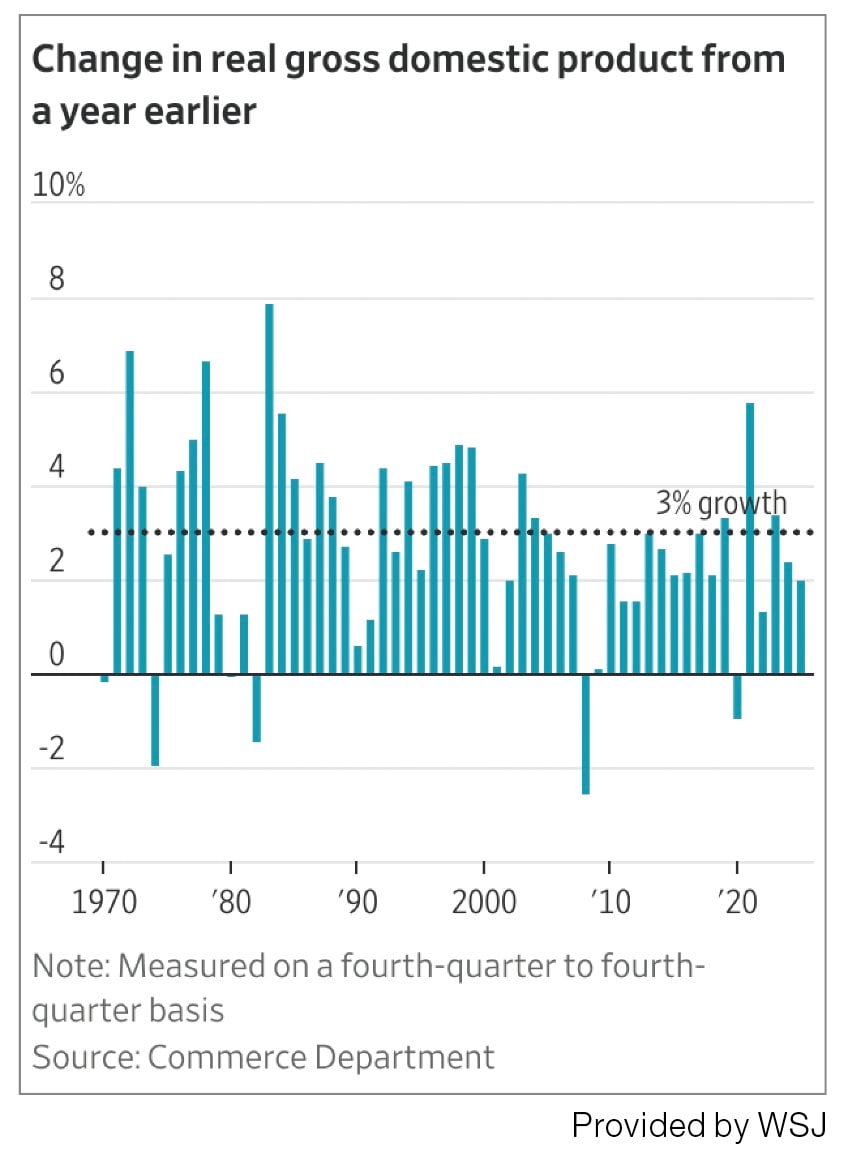
“With 3% growth, we grow our way out of this,” Bessent said at Southern Methodist University last week, arguing that the economy was headed there before the Iran war disrupted energy flows. “We’ll get to the other side of this Iran conflict, and the underlying economy is very, very strong, and I think reaccelerating.”
Bessent and President Trump lean on the growth argument for improving the U.S. fiscal posture while the administration proposes policies that would add to deficits and debt. Trump backs $5,000 postelection checks to adults and a sharp rise in military spending. Some administration decisions are reducing deficits, including tariff increases, antifraud enforcement and cuts to the federal workforce, but Trump also pushed trillions of dollars in tax cuts and a boost in border-security spending through Congress.
Bessent’s rough 3% math would work, according to forecasters, though exact arithmetic depends on several assumptions and targets. The Penn Wharton Budget Model, for example, estimates that average growth of 3.5% to 4% over a decade would stabilize the debt-to-GDP ratio.
Actually attaining and sustaining that growth is what’s difficult.
“We’re gonna take care of the 40 trillion over a period of time through growth,” Trump said on Fox News last week. “We’re growing at a faster rate than we’ve ever grown before.”
U.S. economic growth has slowed over the past few decades. It is not, in fact, setting records. During the second Trump administration, the economy has grown at a 1.9% annual rate. On a fourth-quarter to fourth-quarter basis, the last time GDP cleared 3% was 2023. It has only risen by 3% or more five times over the past 20 calendar years. The economy hasn’t grown 3% on a sustained basis since the 1990s.
Then, the U.S. benefited from productivity gains as companies adopted computers and baby boomers entered peak employment years. Aided by tailwinds from fiscal policy and relative peace, debt declined as a share of GDP to 32% in 2001 from 48% in 1995. Paying off the debt—not doubling it—was the projected path ahead.
This century, the effects powering the ’90s debt reduction reversed. Productivity gains slowed. Baby boomers started retiring. Spending rose with aging and policy changes. Congress cut taxes. Three shocks—the Sept. 11 attacks, the 2008 financial crisis and the pandemic—disrupted economic momentum and prompted major government spending.
The debt-to-GDP ratio is poised to exceed the post-World War II record of 106% by 2030 and keep climbing. The rise is fueled by a structural gap between taxes and spending. The U.S. is running annual deficits of about 6% of GDP, far above historical norms. That means faster growth and bigger policy changes are needed to shift course.
Crossing 100% or 106% or even 120% may not spark a crisis, partly because of the dollar’s centrality in global finance. But Goldman Sachs economists warn that if debt-service costs become painful, Federal Reserve policymakers could face pressure to set interest rates too low, fanning inflation. They also see risks that debt could limit lawmakers’ willingness to fight recessions with fiscal stimulus.
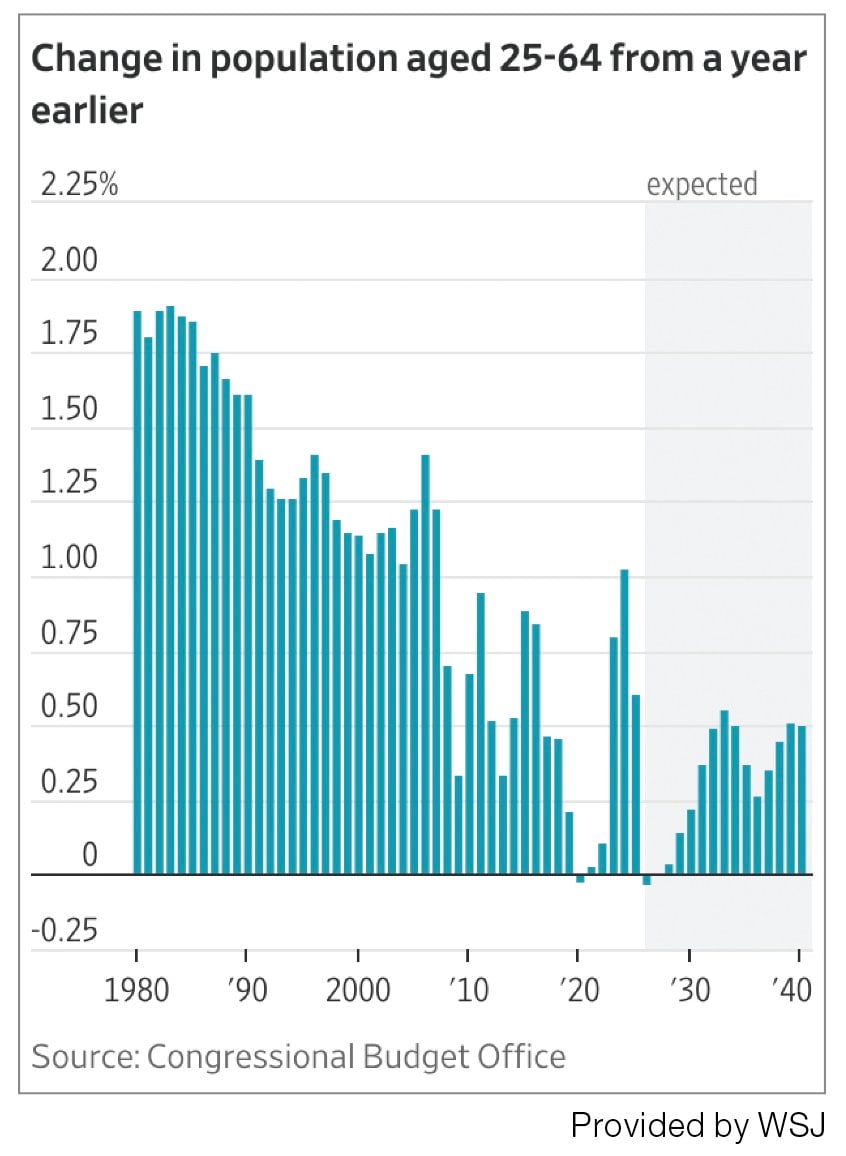
Compared with the 1990s, cranking up growth is harder and relies more on productivity gains. The aging population creates natural constraints on the labor force, which is a key source of growth because more workers mean the economy can produce more.
The Congressional Budget Office estimates that the population aged 25 to 64 will grow 3% over the next decade, or about 0.3% a year. In the 1990s, that population was growing 1.1% annually. And CBO assumes net immigration picks back up after its recent decline.
“You need a mix of legislation and getting lucky on growth to keep the debt-to-GDP in check and right now we don’t have either,” said Don Schneider , a former House GOP aide now at investment firm Piper Sandler.
Accelerating to 3% real growth and staying there—without recessions—doesn’t sound like a big change from CBO’s baseline 1.8% forecast. But it yields an economy that is 34% bigger in 10 years, instead of 20%.
Starting with CBO’s assumptions and adding 0.5 percentage point of productivity growth annually would push GDP growth up to 2.4%. undefined undefined That resembles a 1990s-style productivity boost and would improve the debt trajectory. Tax revenue would climb without increasing rates, but the U.S. would owe higher Social Security benefits due to rising wages. Faster growth would push up interest rates. Because the U.S. owes so much already, higher rates increase debt-service costs, consuming more than one-third of the higher revenues, according to CBO’s interactive tool.
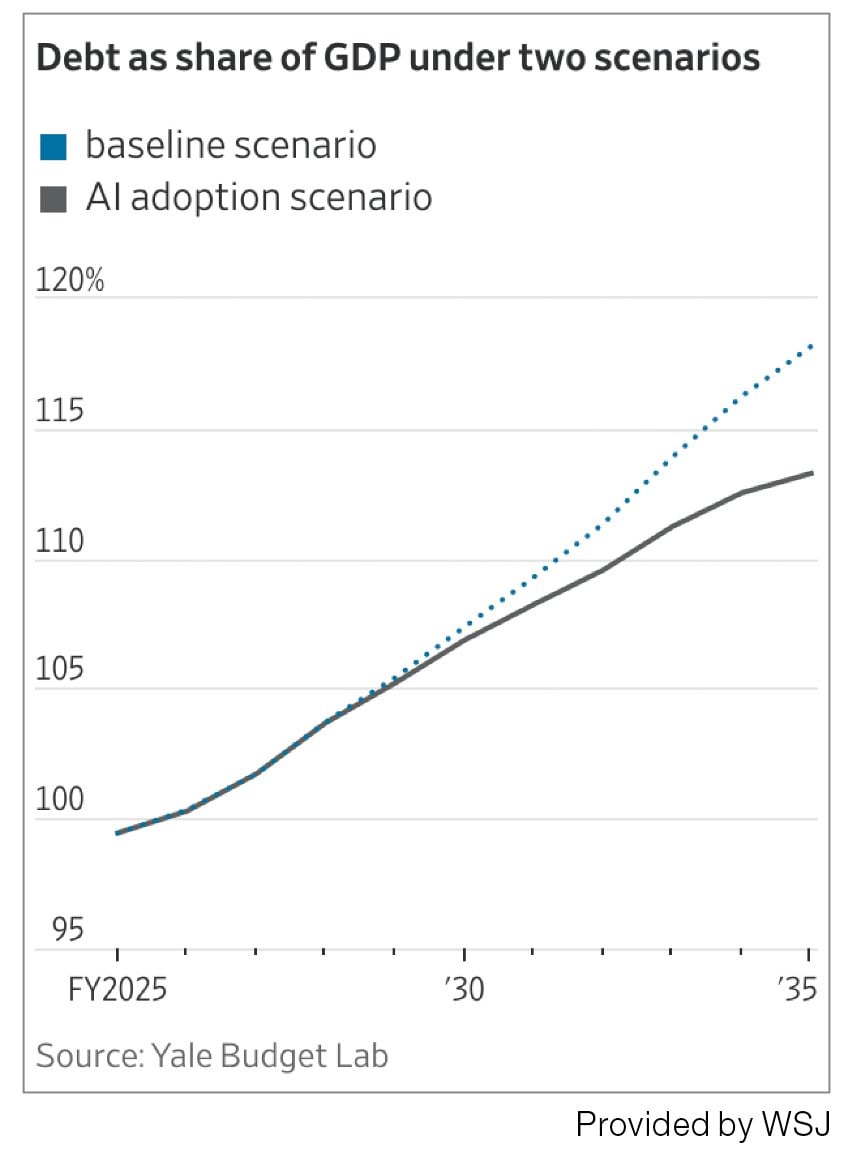
After 10 years, the debt would be 109% of GDP instead of the baseline of 120%—but it would still be climbing.
One plausible source of fast growth is AI-led productivity gains diffusing throughout the economy. A Yale Budget Lab simulation of fast adoption would set growth above 2% and reduce budget deficits. It still shows a rising debt-to-GDP ratio by 2035.
The Budget Lab’s AI-adoption scenario is built from a survey of economists asking how productivity might increase if the new technology can perform many complex white-collar tasks by 2030.
But for debt reduction, more productivity comes with costs, said Basil Halperin , a University of Virginia economist who helped conduct the survey. That is because higher productivity boosts expected investment returns, increasing demand for borrowed funds, which can drive interest rates higher.
AI gains accruing to capital and not labor would generate less revenue because capital income faces lower tax rates. If AI displaces significant labor, higher unemployment could push up government spending.
“The faster productivity growth is from AI, the more likely there will be huge economic and social disruptions that require government actions,” said Douglas Elmendorf , a Harvard University professor who was director of the Congressional Budget Office.
Although Bessent argues that the administration’s tax, trade and deregulation agenda is helping, many economists say Trump’s trade conflicts, Iran war and erratic decisions slow growth.
Bessent has also talked about fiscal consolidation. But that means policy changes to increase revenue or lower spending, which are a tough sell.
“The budgetary items that are really driving the deficit over the next 10 years and the next 30 years and the long term are Social Security and Medicare,” said Stanford University finance professor Joshua Rauh . “Growth alone without any reform of entitlement programs is not going to cut it.”
Trump has ruled out cuts to Social Security and Medicare benefits, but Republicans have cut some spending. Last year’s tax law reduced Medicaid and nutrition assistance.
On revenue, Trump sharply raised tariffs, but the Supreme Court ruled many illegal. Congress cut taxes alongside spending cuts, leaving the debt path largely unchanged.
Some tax cuts, particularly faster write-offs for equipment purchases and factory construction, may reduce revenue now and yield growth. Others, particularly tax cuts for workers, are less likely to spur gains.
“This has been the story,” said Dean Baker of the progressive Center for Economic and Policy Research. “Every time we’ve had a big tax cut, with [George] W. Bush, Trump’s first term, going back to Reagan, it’s oh, we’re going to have great growth.”
免責聲明:本專頁刊載的所有投資分析技巧,只可作參考用途。市場瞬息萬變,讀者在作出投資決定前理應審慎,並主動掌握市場最新狀況。若不幸招致任何損失,概與本刊及相關作者無關。而本集團旗下網站或社交平台的網誌內容及觀點,僅屬筆者個人意見,與新傳媒立場無關。本集團旗下網站對因上述人士張貼之資訊內容所帶來之損失或損害概不負責。