
Full Self-Driving Is the Best Thing About the New Tesla Model Y-By Dan Neil, WSJ



My apologies. Sorry I’m late. I waited a year for Tesla to send me a 2026 Model Y—the so-called Juniper update to its global bestseller. I finally got the hint.
Our guest is a hardworking, well-groomed Model Y Premium RWD that I hooked up with through Turo, the peer-to-peer car-sharing platform. Crucially, this example featured Tesla’s Full Self-Driving (FSD) system, running the latest Version 14 software—an AI entity educated on Tesla’s vast store of user-generated video. We’ll meet it later.
Six years ago I proclaimed the original Model Y the best car in the world, and the world agreed. The family-sized four-door hatchback went on to lead global sales of all passenger vehicles over the three-year period, 2023-2025. I’m that powerful.
Lately, however, products from Chinese and European rivals have overtaken the Model Y in a number of fundamental metrics. BMW’s Neue Klasse-based iX3, for example, has a claimed range of 383-434 miles—up to 140 miles more than Model Y, depending on configuration. The BMW also boasts a faster charging, 800V-nominal electrical architecture; the Model Y retains a 400V system. The Model Y’s charging rate maxes out at 250 kW. Most fast-charging networks now operate up to 350 kW.
So while the Model Y is a better machine in many ways—stronger, lighter, smarter, more efficient—the question is, is it enough? My conclusion: Without FSD, it wouldn’t be.
The Model Y’s pitch starts with an altogether reasonable price. The Premium RWD now starts at $45,490, several thousand lower than the first-gen’s price point.
Never exactly its strong suit, the exterior gets a makeover with the revised front end, incorporating a transverse lightbar between the sidemarker/turn signal assemblies. The updated taillight assemblies and deck lid treatment luxe up the rear end nicely. Please note that the entry-level Model Y retains the previous, grumpy catfish face, for the sullen ichthyologist in your life.
Sitting in the driver’s seat at the Charlotte Douglas International Airport, I tried to remember how to make these cars go. The Model Y’s human-machine interface doesn’t include a typical gear selector. The primary direction selector/indicator resides in the upper left corner of the center touch screen. Should the primary screen become disabled, a secondary gearshift selector hiding in the headliner will illuminate.
However, in most situations, the Model Y’s awareness is such that it already knows whether you want to go forward or back. You don’t even have to start it.
I slipped the brake and the car gently reversed out of the parking space. I stopped again and it selected D for Drive. I squeezed the accelerator and off we went.
Tesla’s hyperminimalist approach to human factors is not without its detractors. Chinese regulators have pushed back on screen-only controls for certain safety-related vehicle functions, such as windows and doors. I note that the Model Y retains a conventional turn-signal stalk, while previous designs, like Cybertruck, placed the turn-signal controller on the steering wheel.
The center touch screen is now 16 inches, slightly larger than before, with a higher resolution QHD touch display. The rear passengers have their own 8-inch screen for hotel adjustments. The Model Y is, of course, connected out the wazoo, with cellular data, Wi-Fi, ultra-wideband and Bluetooth. It even has FM radio (except in base trim).
What it doesn’t offer is Apple CarPlay nor Android Auto. I know a lot of car-shoppers consider that a disqualifying offense. I also understand the comfort of the familiar. Even so, Tesla’s proprietary digital environment works beautifully, looks great and blazes away, faster than you can swipe.
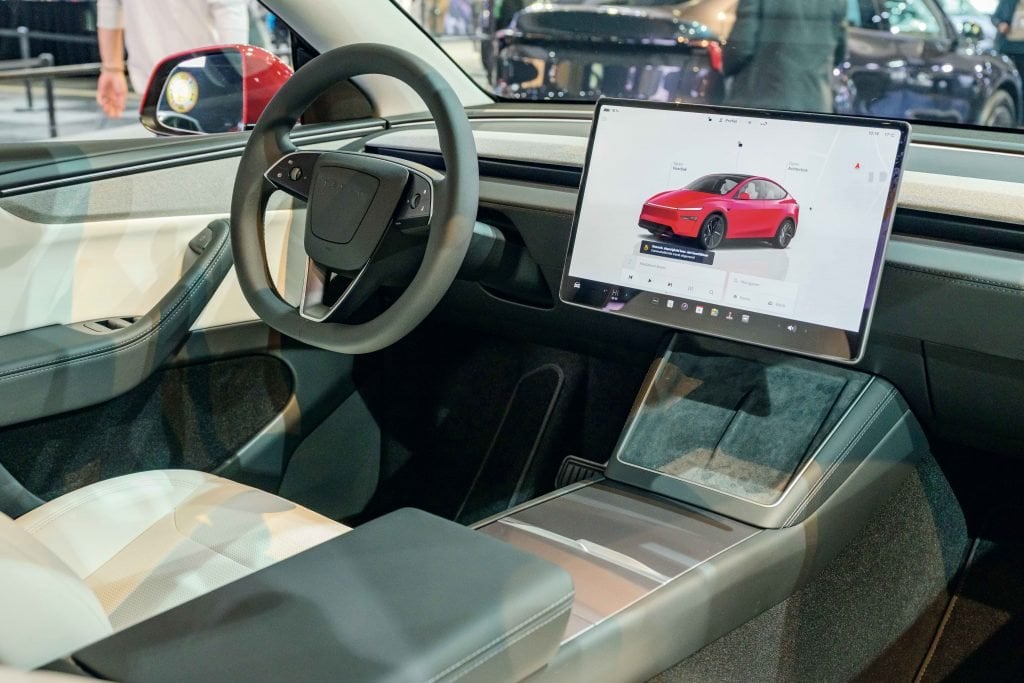
I was still fiddling with the controls when I inadvertently engaged FSD’s route-following function. Instantly the car understood “Home” and seized control of the steering wheel, crisply merging right to catch the exit for Interstate 77 North. It felt like being kidnapped.
Checking the display, I realized FSD was taking me to the owner’s house on a preset route. The latest version offers five drive modes: Sloth, Chill, Standard, Hurry and Mad Max. Our car had been set to Hurry, and it did just that—sweeping past interstate traffic on the left and right as if I were late for my wedding.
Rather than arrive unannounced at the owner’s door, I pulled over and reset my destination to a golf course about 25 miles away. I tapped the FSD button and just…let…go.
Letting go was hard. After all, I’m an excellent driver, Charlie. Yours truly vs FSD is like Kasparov vs. Deep Blue. I held my breath as the car worked its way out of the shopping center parking lot, briefly skirmishing with incoming traffic at a poorly marked four-way stop. Then—with humanlike fluency I might characterize as confidence—FSD put its invisible foot down, moving over two lanes to anticipate merging traffic far ahead and put us in the fast lane. Nicely done.
Trust didn’t come all at once. For the first half-hour or so I was reflexively covering the brake pedal at intersections and merging lanes, ready to engage if the super-intelligence at the wheel did something stupid. It felt a bit like the old team-building exercise where people fall back into other arms, except with 4,000-pound vehicles.
But mile by mile, the FSD started to earn my confidence. In the whitewater-like eddy and flow of rush-hour interstate traffic, the FSD held its position beautifully: stopping distances, following distances, lane centering, the gradients of acceleration, steering and braking, all playing out in smoothly continuous linear functions. FSD drives at least as well as Coach Vestal, my high-school driver’s ed teacher.
After the golf course, I put in a few more destinations—the Sullenberger Aviation Museum, the Omni Hotel downtown—and kicked back while the car contended with traffic. I often noted FSD’s tolerance, its spontaneous collaboration with other motorists, and—when confronted with jackass behavior—its emotional maturity. How eusocial of it.
By the end of the second hour—partly spent traversing grid-patterned streets to avoid an accident—I was bewitched. FSD is amazing. I acknowledge I am a sample group of one, with only the scantest evidence to work with. Still, I know good driving when I see it.
I also understand why Tesla buyers have been willing to pay thousands extra for FSD. At least they were. Tesla recently announced that the latest versions of FSD will be available only by subscription, charging $99 monthly. That doesn’t seem particularly superintelligent. Tesla just made the best thing about the Model Y optional.
Maybe those terms will change. If they do, I’ll be waiting.
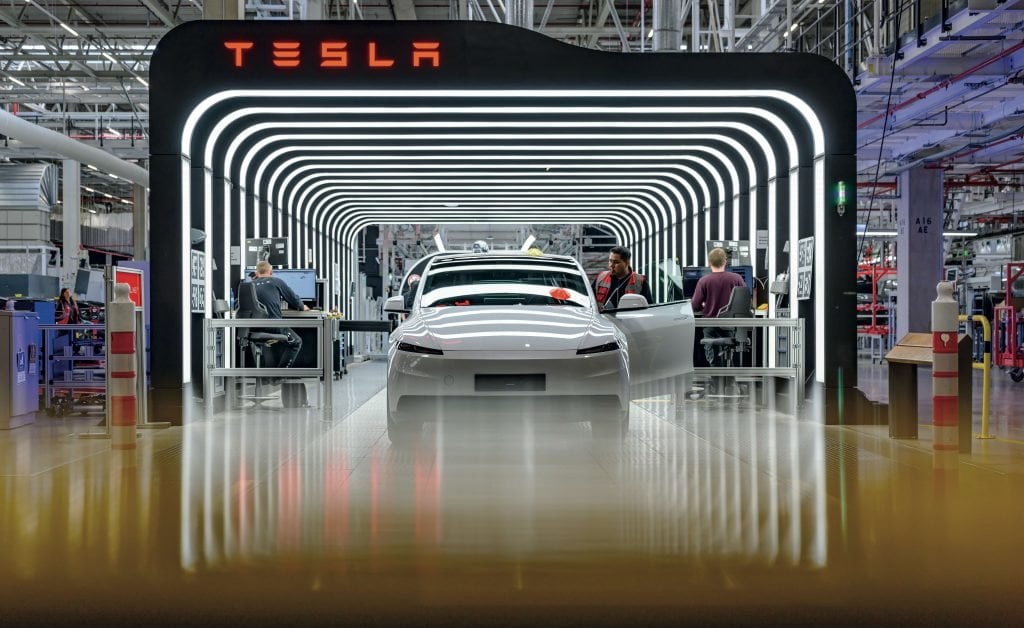
smarter, more efficient—the question is, is it enough? My conclusion: Without FSD, it wouldn’t be.(圖片來源:Photo by Patrick Pleul/picture alliance via Getty Images)
2026 Tesla Model Y Premium RWD
Base price $45,490*
Price, as tested $49,130*
Powertrain all-electric; rear-mounted permanent-magnet motor; (estimated)75-kWh lithium ion battery; rear-wheel drive.
Net system power/torque 295 hp/325 lb-ft
Length/wheelbase/width/height 188.6/113.8/83.8/63.9 inches
Curb weight 4,184 pounds
0-60 mph 5.4 seconds
EPA range 357 miles
Cargo space 76 cubic feet
*Prices are in USD
免責聲明:本專頁刊載的所有投資分析技巧,只可作參考用途。市場瞬息萬變,讀者在作出投資決定前理應審慎,並主動掌握市場最新狀況。若不幸招致任何損失,概與本刊及相關作者無關。而本集團旗下網站或社交平台的網誌內容及觀點,僅屬筆者個人意見,與新傳媒立場無關。本集團旗下網站對因上述人士張貼之資訊內容所帶來之損失或損害概不負責。