

CIOs Say Companies Tighten Focus on AI Outcomes-By Tom Loftus,WSJ



Good morning. Hope you enjoyed the extra hour of sleep, because this week is going to be a doozy, between the midterm elections and another reckoning of the artificial intelligence boom, with Apple, Palantir, Qualcomm and AMD delivering earnings, among others.
Last week’s tech selloff was bruising enough—although Microsoft , Alphabet and Amazon all reported strong cloud growth last week, a rough proxy for AI demand—as investor anxiety grew over how much AI companies are spending on infrastructure and how that spending is financed.
But it’s important to note that amid the chaos, we’re hearing one throughline: While Wall Street may be losing its nerve over AI, corporate buyers aren’t. The WSJ Leadership Institute late last week reached out to CIOs and tech insiders and found no slowdown in enterprise demand for AI, although market jitters could push them toward a sharper focus on outcomes.
Here is what Belle, Isabelle and I found:
Two Separate Tracks
Mike Kempe, CIO of Grant Thornton, told us that he draws a line between the companies building AI and those using it. Building AI infrastructure and applying AI inside a business are “two very different economic models,” he said. “At the enterprise level, the greater risk may actually be waiting too long to engage.”
If anything, he said, the market’s reaction “reinforces the need for companies to be thoughtful about where they invest and how quickly those investments translate into business value.”
The Selloff: A Good Thing for Enterprise AI?
Tim Crawford, founder and CIO strategic adviser at advisory firm AVOA, told the WSJ Leadership Institute that last week’s selloff is healthy from a certain perspective.
“It takes some of the froth, some of the hype, and starts to reprice where the actual demand is,” he said.
“It won’t change the dynamics for the enterprise,” Crawford said. “They’re still going to buy what they’re going to buy.”
If anything, Wall Street turmoil could help CIOs refocus.
Ravi Soin , CIO and CISO at Smartsheet , agreed. “The selloff is more a reflection of when the returns are seen than of AI demand,” he said. He expects customers to demand clear business cases and shorter payback periods, and to run fewer open-ended experiments. “Spending will not cease, but it will become more selective,” he said.
A Possible Advantage for CIOs
Enterprise buyers say the market turmoil isn’t changing how they choose AI and cloud providers. “We judge our providers based on their capability to help us, which is not correlated to investor sentiment about big tech companies,” said Greg Meyers, executive vice president and chief digital and technology officer at Bristol Myers Squibb.
What matters, he said, is why a stock is falling. A pullback driven by valuation is “not a big deal.” But a decline caused by deteriorating fundamentals “is a watch sign because companies that are not executing well will be forced to cut R&D spending.”
A sagging stock price can even be an advantage. “Oftentimes I find that when valuations of providers retrench, it actually increases our leverage, especially during contract negotiations,” Meyers said.
Demand Is Only Rising
“Every enterprise leader I talk to is constrained by compute, talent and change management, roughly in that order. None of them is constrained by enthusiasm, Adnan Masood, chief AI architect at UST, told us.
Masood doesn’t expect hyperscalers to cut frontier investment, since demand for compute still outstrips supply. “What we may see is resequencing, with some capacity arriving a quarter or two later than planned,” he said.
At the same time, Masood expects boards to judge every AI dollar on production metrics such as cycle time and cost per transaction. “That is capital discipline, and it is healthy,” he said.
R “Ray” Wang, founder and chairman of Constellation Research , said that while some AI developers may not survive, capacity will still be needed.
“Customers are more worried about making AI work,” he said. undefined undefined That means asking harder questions about what each deployment costs and what it delivers and whether any given task should be automated. “When and where you insert a human is more important than when and where you automate,” Wang said.
The Next Stage
To Sarab Narang , CEO of Glob.AI , Globant’s AI-native services platform, recent events signal that “the era of AI experimentation is over.” Investments will continue as planned, he said, “but with a lot more focus on getting their customers to outcomes.”
Grant Thorton’s Kempe sees the next phase of AI to follow as a matter of discipline, not retreat. “I would distinguish greater discipline from reduced commitment,” he said. “For large enterprises, I believe this is the time to lean in.”
Readers, are you still leaning in? If so, what would it take for you to pull back? I would love to know. Send your feedback to me at thomas.loftus@wsj.com (if you’re reading this in your in, you can just hit reply).
AI Diffusion Varies Across Industries
Research firm SemiAnalysis has launched a new benchmark that measures frontier model capabilities in specific industries where AI is likely to have the biggest and earliest impact. The GDPx benchmark helps create a framework for understanding how AI is spreading through the economy. That is particularly important right now as the investment case for AI comes under scrutiny especially in the public markets.
“We believe the first trillion dollars of AI revenue will be concentrated in sectors that can deploy frontier intelligence at high ROI, not broadly diffused throughout the whole economy,” SemiAnalysis said. It maintains that building a general-purpose benchmark is therefore a mistake. “If your goal is to track the progress of frontier models, you should focus on the domains where they will be most impactful,” the firm says.
It highlights 11 domains to watch right now, including chip design, cybersecurity, biology, finance, legal, quant trading, recursive self-improvement, hardware design, materials science, alignment and software engineering.
“Intentionally forgo industries like government, real estate and insurance,” SemiAnalysis says.
The research evaluates the models under a variety of scenarios, including the impact of safety classifiers on performance. Anthropic ‘s Claude Opus 5.5 led the main leaderboard with a score of 12%. “If we exclude cyber, biology and alignment—the three domains where safety classifiers sometimes kick in,” OpenAI ‘s GPT-6 Astra scores highest with 11.8%.
Meanwhile…
•Lenders and investors are turning choosier on AI financing , demanding tougher terms as political backlash, a Fed rate hike, weak tech earnings, and a flood of stock and bond offerings stoke fears that AI profits will lag behind. “The bar is going higher and higher in terms of proving to lenders that this investment will turn into sufficient revenue,” Dan Ivascyn , chief investment officer at Pimco, tells The Wall Street Journal. “The weak links are going to suffer first.”
•As those weak links start to wobble, investors and tech executives are increasingly buying insurance through put options, credit-default swaps and new compute-price derivatives, the Journal reports.
•OpenAI has secured about $11 billion of the $30 billion it sought in its latest funding round, at a $1.25 trillion valuation—less than the $1.4 trillion valuation that it had earlier hoped to achieve. The shortfall comes amid a tech selloff tied to disappointing earnings results and as OpenAI prepares for a possible IPO as early as next year.
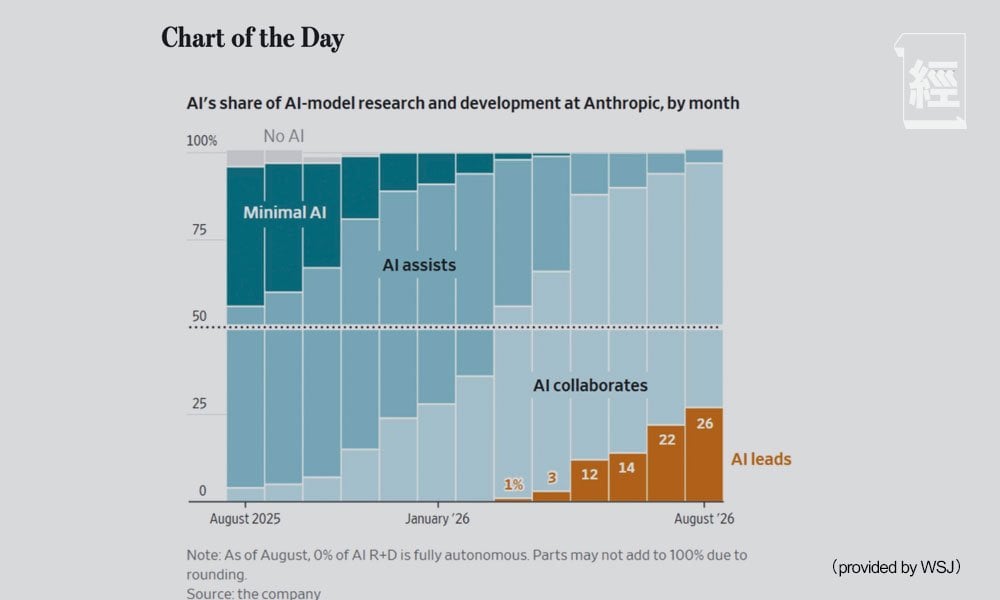
The WSJ’s Ben Cohen writes that our best data about signs of AI “recursive self-improvement” comes from Anthropic, which recently published a chart showing how much of its AI research and development is being done by AI.
The WSJ Technology Council
The WSJ Tech Council brings together CIOs, CTOs and CISOs advancing innovation and shaping the future. Join this trusted community where tech executives connect with peers to explore emerging trends and gain the perspective they need to stay ahead of disruption.
(圖片來源:資料圖片)