

How France Became the Poster Child for Debt Woes-By James Mackintosh,WSJ



France has emerged as the biggest victim of soaring global yields. Its troubles are the same as most other countries, only more so.
As the strong U.S. economy drove inflation and interest rates higher, investors began to look for the weakest links, the companies and countries that won’t be able to cope with higher borrowing costs. They landed on France, whose indebted government has been able to muddle through financially only thanks to superlow rates.
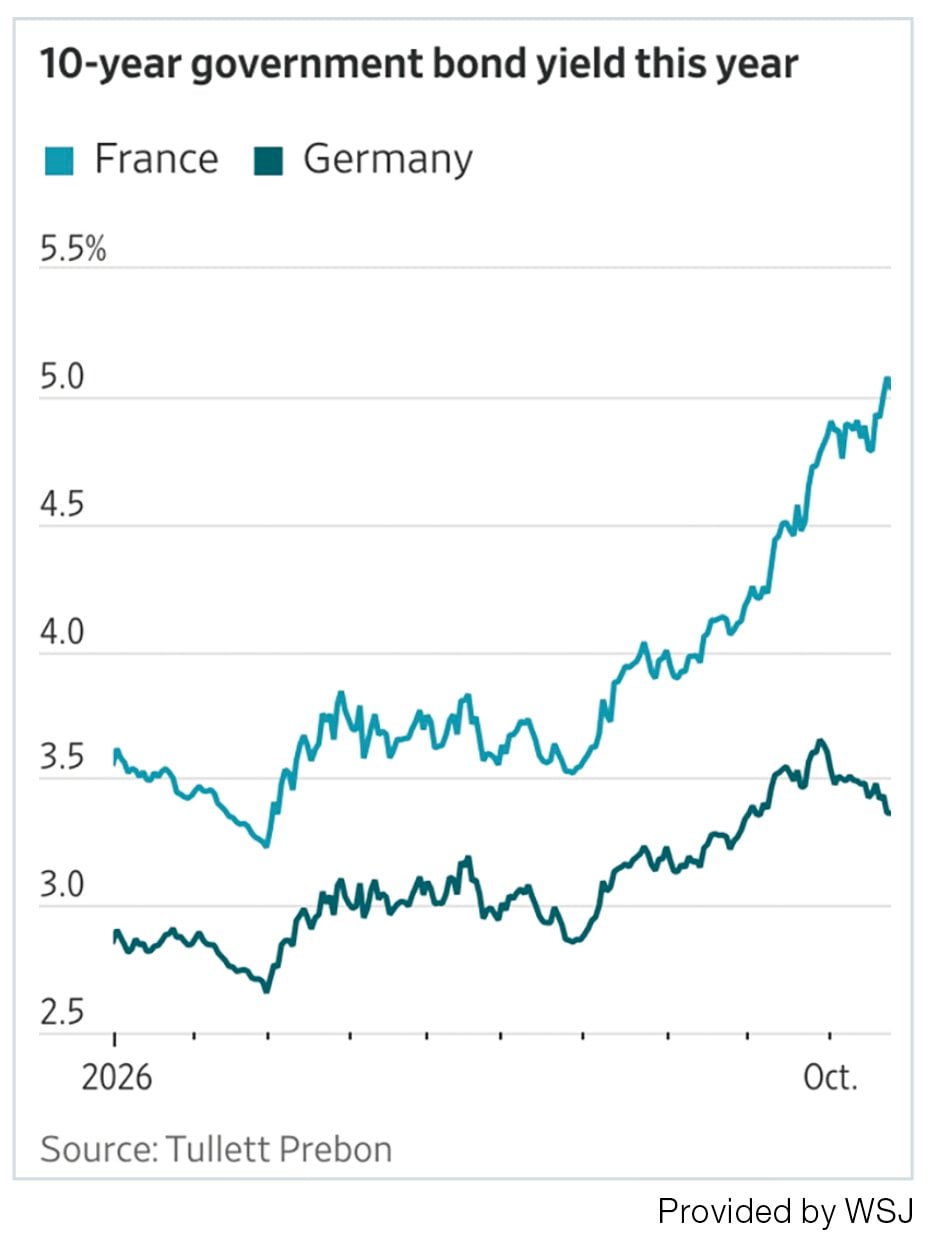
After the damage was done, last week’s big drop in U.S. Treasury yields didn’t help France, with its 10-year yield hitting a 24-year high on Thursday.
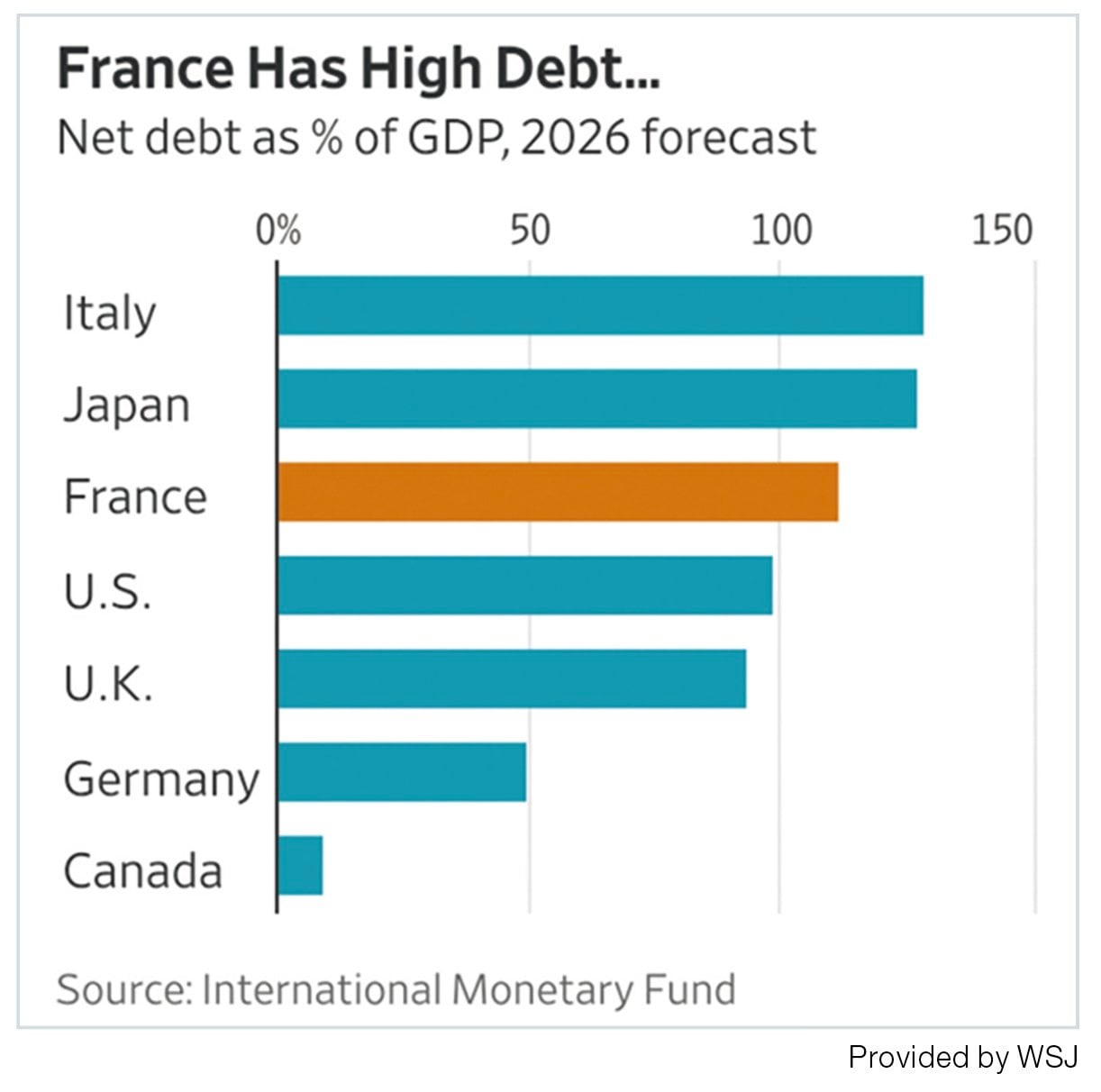
France has three deep-seated problems. It already operates close to the financial limit where new taxes hurt revenue rather than help. It appears to be at the political limit where voters won’t back either higher taxes or spending cuts. Put those together and its net debt, predicted by the International Monetary Fund to pass 111% of gross domestic product this year, is unsustainable.
Something has to give, and bond selling led to more bond selling as hedge funds and others who had bought into France for the “carry,” or higher yield, were dislodged. Yet yields are still not high enough to make the French populace realize it needs to take the debt seriously.
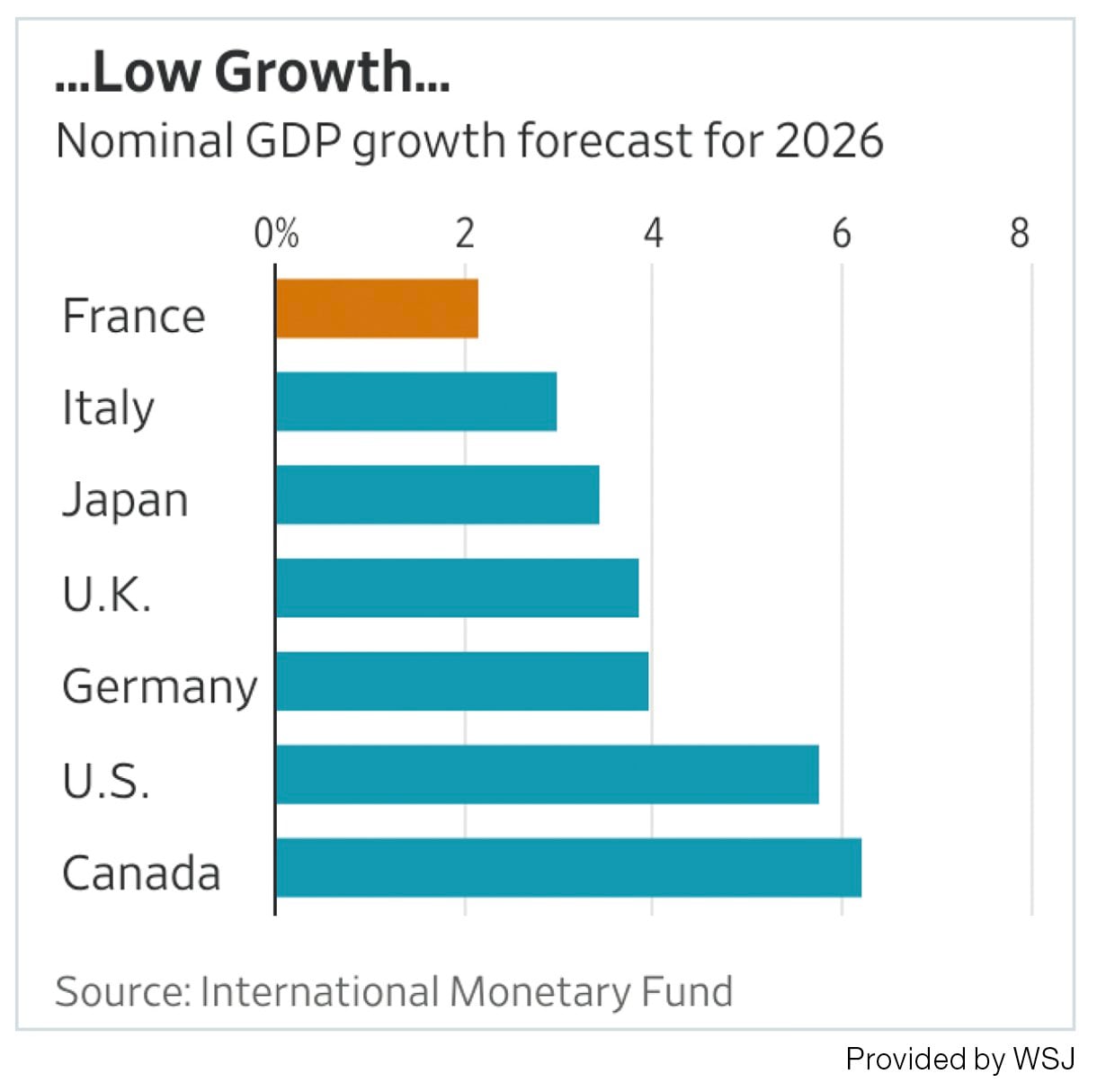
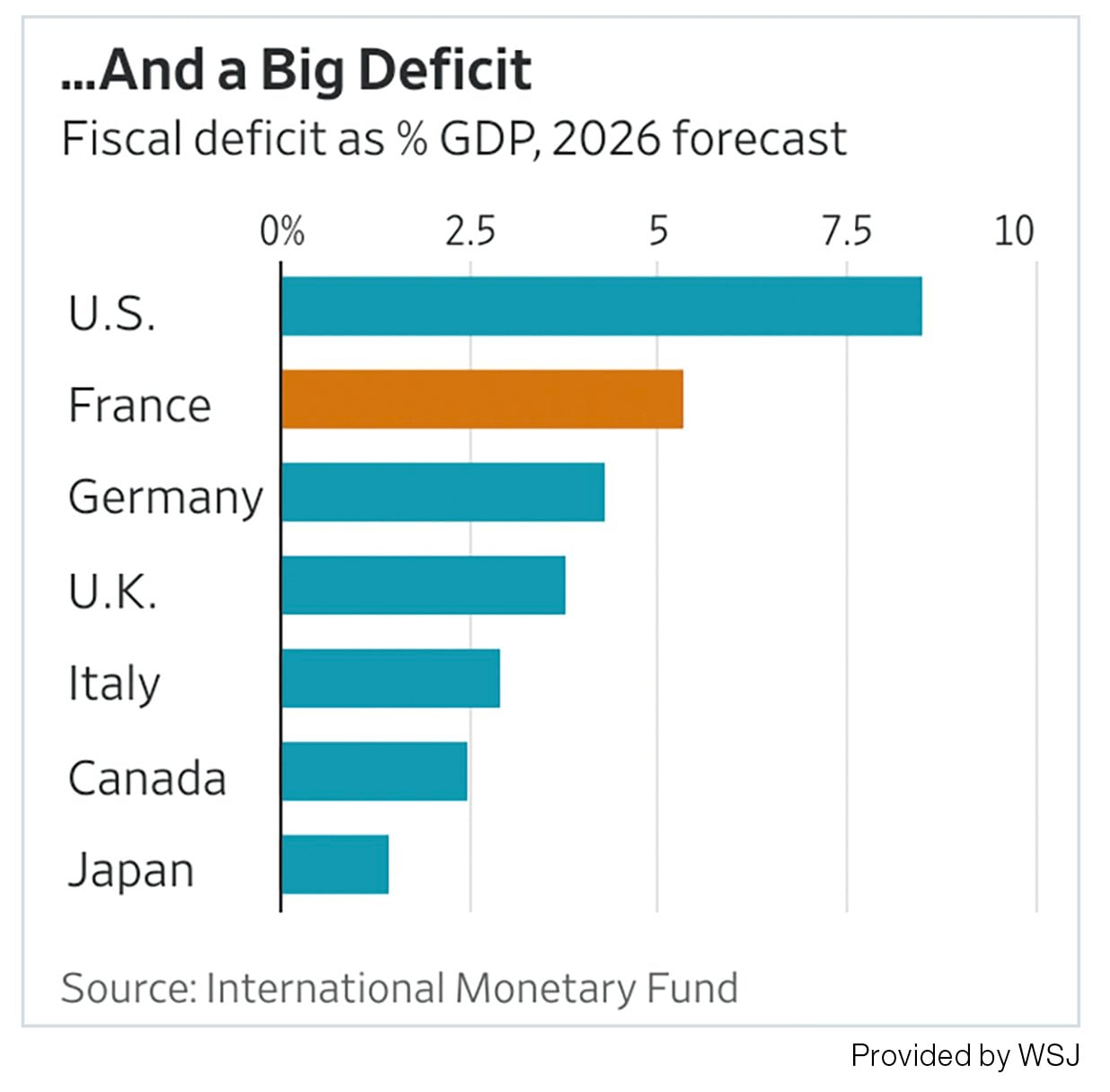
The mathematics of the problem is fairly simple. France is running a budget deficit of about 5% of GDP, and nominal growth—real economic growth plus inflation—is forecast to be 3% at best. Since taxes broadly rise in line with a growing economy, the government needs to raise new debt of 2% of GDP a year.
That might not sound too bad. But France is already sitting on a huge debt pile and rising interest costs make the fiscal deficit worse every year, as cheap debt from the zero-interest-rate era matures and is replaced by new debt at much higher cost. Last week the French 10-year yield briefly passed 5% for the first time since 2002, when the country had much less debt and better growth prospects.
If it were paying 5% on all it owes, the country would be adding debt amounting to 4% to 5% of GDP a year, and facing a death spiral of rising yields and rising interest costs. Investors looking to the future wonder why they should bother taking the risk that France fails to rein in its finances, for what is still not an especially high yield by global standards.
The financial solution isn’t all that hard. France needs to cut spending (tax and other government revenue is already 52% of GDP, higher than all developed countries bar oil-rich Norway and tiny Finland). It doesn’t have to do it right now, but a plausible plan that convinced investors it would move toward a balanced budget before interest costs over a decade or so would take the pressure off. Government spending would still be higher than Germany’s, where it makes up just over half the economy, and cheaper debt would itself help the deficit.
The political limit is the real challenge, as anyone who has invested in emerging markets knows. Countries almost always default not because they can’t pay their debts, but because they won’t: Politicians aren’t willing to inflict the pain of lower spending or higher taxes to meet their promises to investors.
It isn’t only France’s unsustainable debt, extreme politics and riots that liken it to an emerging market. It has also borrowed in a currency its government doesn’t control. Paris can’t print euros to avoid problems; if things get much worse, it would have to beg the European Central Bank for help, not simply order the Banque de France to buy its debt.
We are a long way from crisis, though, and a bond yield of 5% is nowhere near the level that would have emerging-market finance ministers adding the IMF on speed-dial.
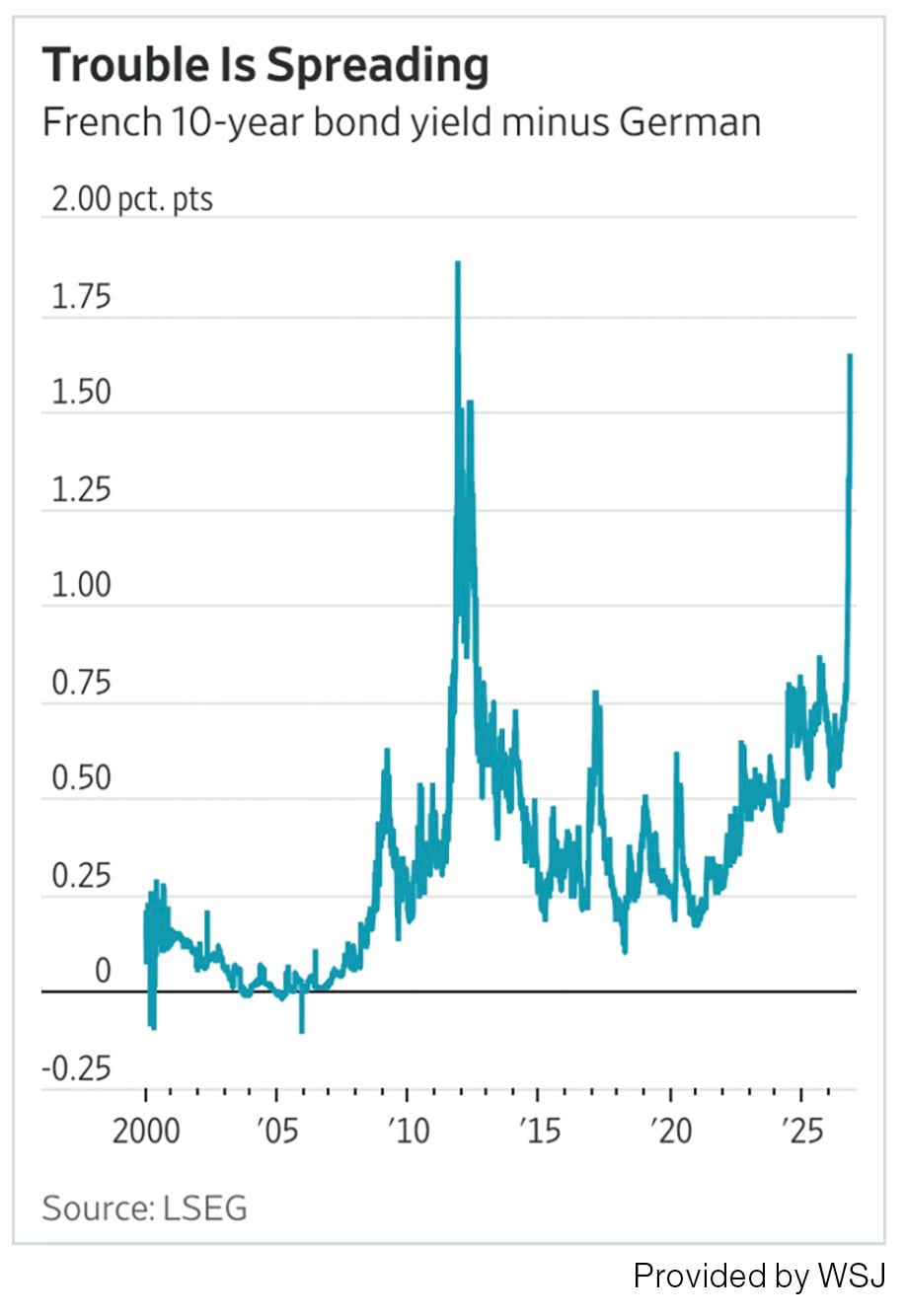
The French yield isn’t at panic levels compared with Germany, either. “ Le spread ,” the extra yield on French 10-year bonds above German ones, is at about 1.5 percentage points. That is worrying, in that it is the highest since the eurozone crisis of 2012.
But we should remember that back then France was seen as one of the grown-ups, getting together with Germany to force Greece into a painful default and other weak eurozone nations into austerity. Italy was the country refusing to adjust, and its 10-year spread over Germany hit an eye-watering 5.5 percentage points before the prime minister backed down and quit.
Europe is more organized today, and the ECB would probably step in to buy French debt long before financial markets got so panicked.
We are still at the stage where it could all work out, if the next president were both to want to cut spending and to have enough support in parliament. On current polling, however, that would probably be Marine Le Pen of the far-right National Rally, and there are major question marks over her willingness and, if she wins, power. Le Pen has previously backed lowering the pension age to 60 from an already very low 62, which would make France’s expensive state pension even costlier. Her party helped force President Emmanuel Macron to reverse his signature reform, a rise in the pension age to 64, just last year. And the next president doesn’t automatically control parliament, which is divided into three antagonistic blocs.
For me, the deeper problem is one familiar everywhere. Roughly half the electorate thinks the government can finance itself by adding debt or taxing the other half of the electorate. The old debate was between a left that thought taxes should be higher to finance more state spending and a right that wanted lower spending to allow tax cuts. After the constraints of the gold standard fell away in the early 1970s and borrowing costs fell from the early 1980s, both left and right could get their way, with debt filling the hole.
Four decades later, the debt in many developed countries is getting too high to just buy off the voters, but the political debate mostly ignores it. It isn’t only France that needs to get serious.
免責聲明:本專頁刊載的所有投資分析技巧,只可作參考用途。市場瞬息萬變,讀者在作出投資決定前理應審慎,並主動掌握市場最新狀況。若不幸招致任何損失,概與本刊及相關作者無關。而本集團旗下網站或社交平台的網誌內容及觀點,僅屬筆者個人意見,與新傳媒立場無關。本集團旗下網站對因上述人士張貼之資訊內容所帶來之損失或損害概不負責。