

The New Congress Must Fix the $40 Trillion Debt—and Soon-By Jack Hough,BARRON'S



Voters have spoken, and Congress has flipped blue, to counter a Republican White House. Which side will get its way? Increasingly, neither, and not just because of gridlock. America’s debt will write more of the rules from here.
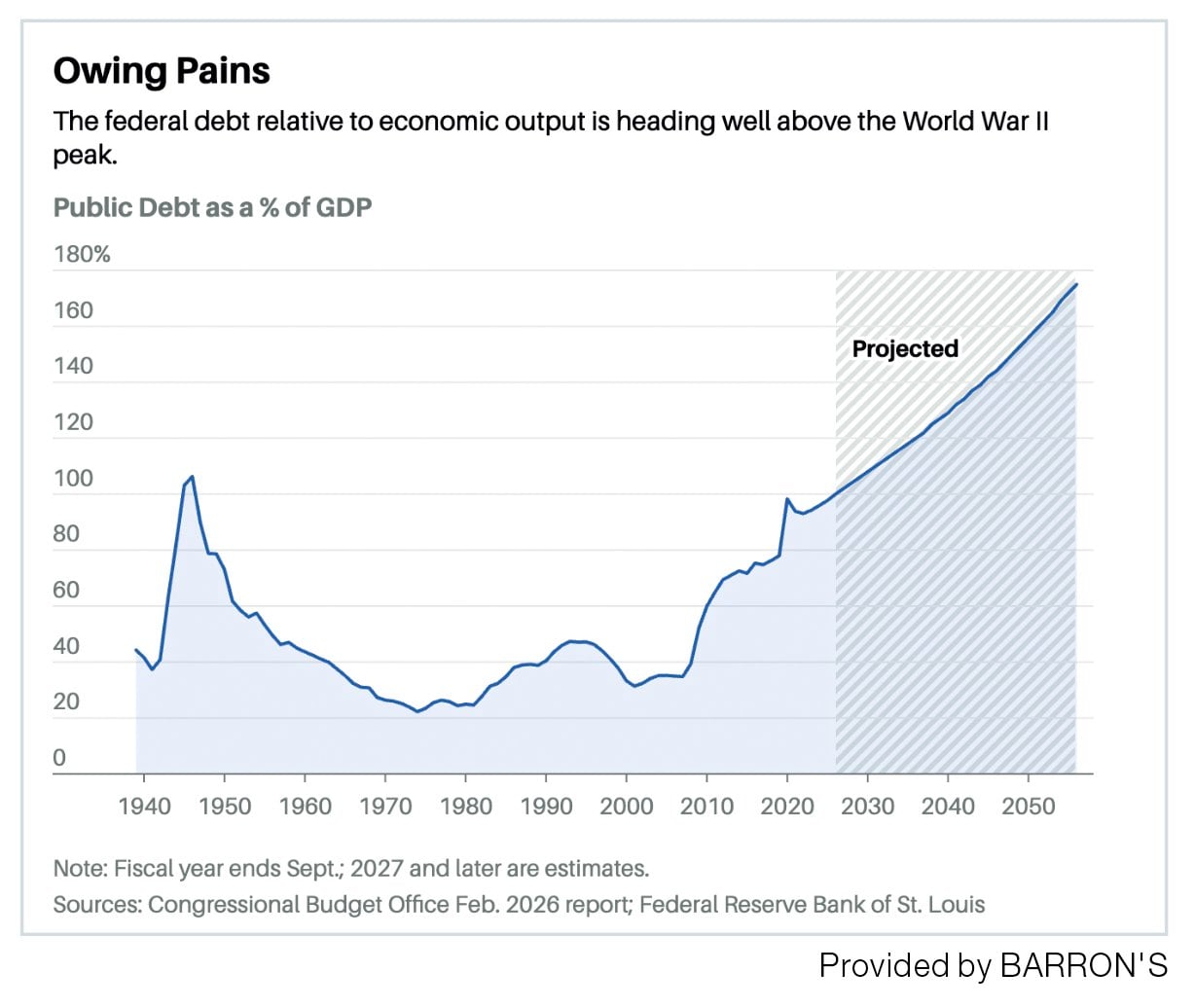
The amount owed recently eclipsed the size of the economy, you might have heard. That happened once before, during World War II, when the primary driver was temporary, and kind of a biggie: converting the world’s largest economy into a global war machine deployed across two oceans to help free humanity from fascism. We’ll top that peak soon, probably by the end of the decade, only now the money is spent mostly on autopilot old-age programs and compounding interest.
Interest almost single-handedly explains why massive and growing deficits, or amounts added to the debt each year, are the new normal. This year’s deficit is pegged at $2 trillion, or 6% of the economy, an unprecedented high during a peacetime economic expansion. The interest bill is likely to be $1.1 trillion, or more than half of the deficit. A decade from now, it will be $2.1 trillion, or 69% of the deficit, which will itself have risen to 7% of the economy. That projection comes from the Congressional Budget Office, and it is almost certainly too optimistic, because Treasury bond yields recently jumped above levels the CBO used in its math.
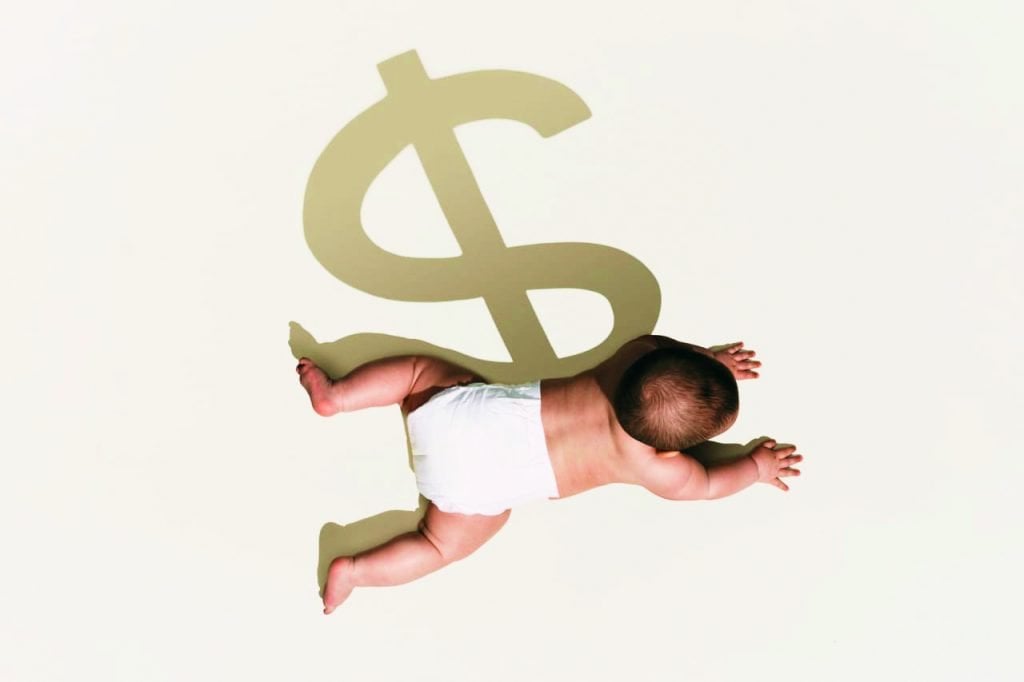
The unbothered fellow shown above doesn’t literally owe $40 trillion, we’re happy to report. For one thing, that’s gross debt. If we subtract amounts owed by one part of the government to another, debt held by the public is closer to $32 trillion, slightly ahead of gross domestic product. By 2050, when today’s youngest are out of college, debt will have swelled to 150% of GDP, the CBO reckons. Barron’s , using projections from the Census and Internal Revenue Service, estimates that by then, the amount owed per taxpaying household will total $1.3 million, or discounted back to today’s purchasing power, about $700,000. That will be like entering the workforce with a hefty mortgage, but not the house it bought.
Voters have heard similar warnings for more than 30 years, and the math grows ever worse while the consequences never seem to arrive. But look around. The 30-year mortgage rate has jumped a point in a year, to 7.2%, paralyzing buyers and sellers. It might be only the beginning. Inflation, recently 3.7%, hasn’t been below the Federal Reserve’s 2% target for more than five years. For the past two years, the Fed had been lowering its core federal-funds target rate, but in September it shifted to a quarter-point hike, to 4%. Torsten Sløk, chief economist at Apollo Global Management, recently calculated that the Fed would have to keep hiking all the way to 6.75% by the end of next year to bring inflation down to its target. Get ready for 10% mortgages, or else a lot more growth in the cost of living.
Watch out for wilder stock swings, too. Investors in recent decades have gotten used to speedy rescues from market downturns in the form of slashed interest rates and lavish government spending. But what if high inflation and a cranky bond market don’t allow for these interventions? Deutsche Bank macro strategist Henry Allen calls it the end of the safety net. “People should prepare for a world in which volatility of the kind we haven’t seen in many years is kind of normalized again,” he says.
Your reporter writes a debt scolding once or twice a decade. He has taken pains over the years to express equal disdain for both political parties, neither of which has wrapped itself in fiscal glory. If the Democratic takeover says anything about the nation’s budgetary mood, it might have little to do with Democrats. In what has somehow become a forgotten footnote to this election, a sitting president offered $5,000 checks as a perk if his party won, but voters went in a different direction. They probably didn’t take the offer seriously. Or maybe they’re just tired of debt-funded gimmicks.
Let’s turn now to possible paths from here. What does it mean to inflate the debt away, and is that feasible? Is a grand political bargain out of the question? What’s Japanification, and what role might bond vigilantes play? Could an artificial-intelligence growth miracle bring the debt back in line? Read on for thoughts on each of these, and how investors should prepare.
The ‘Inflate It Away’ Fantasy
In a recent Deutsche Bank survey that asked how the U.S. will ultimately deal with its debt, respondents overwhelmingly chose political cowardice. That is, they favored paths that don’t require Congress to act. The top prediction is that America will run inflation hot, which we’ll look at now. A close second was that it will muddle through indefinitely, which we’ll come to.
By 1946, America and its allies had prevailed in war, but U.S. debt was left at 106% of GDP—still the record, for a little while longer. The government then allowed most prices to soar, which flattered economic growth, and by 1960, debt was back to 60% of a much higher GDP. Easy peasy? Let’s dig deeper.
The Fed, which back then worked for the Treasury, had capped bond yields starting in 1942, just after Japan attacked Pearl Harbor. The short stuff paid 0.375%, and the long, 2.5%. Patriotic savers, flush from wartime rationing, had lined up for 10-year war bonds, while institutions bought 20- and 25-year paper. As soldiers returned to factories, inflation roared, hitting 8%, then 14%, then 8% over three years ended in 1948. Unrest boiled over. In 1946 alone, more than four million workers walked off their jobs during nearly 5,000 strikes. President Harry Truman at one point threatened to draft railroad workers into the military to force them back to work.
Inflation is a kitchen table issue, and an electoral one. The 1946 midterms were called the Beefsteak Election. To appease angry workers, Truman kept many wartime price caps in place, including for beef. Ranchers, rather than sell at losses, put their cattle out to pasture. Pork ran short, too. Big city butcher shops hung cardboard signs, “No Meat Today.” High-end restaurants paid dearly for black market cuts, while ordinary families ate macaroni and beans. Hospitals appealed for emergency meat allotments to feed the anemic, and at least two resorted to serving horse. Truman briefly considered sending the military to seize pasturing cattle. Weeks before the midterms, he lifted price controls on meat. Republicans nonetheless swept Truman’s Democrats from control in the House and Senate.

Caps on yields remained in place for years. Return on investment for those 10-year war bonds was, well, freedom from tyranny on one hand. But on the other hand, it was negative 20% to 30% after inflation.
Could the same playbook work today, minus maybe the missing beef? Unlikely. After WW II, military spending plummeted from about 40% of GDP to under 5%, but today, there’s no end in sight to government spending, because most of it is for Social Security, Medicare, Medicaid, and interest. And let’s not get hung up on “waste, fraud, and abuse,” that half-century chestnut of American political rhetoric. There is squander in the spending, to be sure, much of it concentrated in Medicare and Medicaid. But the nonpartisan Government Accountability Office estimates all “improper payments,” including fraud and errors, at $175 billion to $235 billion a year. That amount should burn voters’ biscuits, but we’ll need to capture 10 times as much yearly savings just to keep from sinking deeper into the debt hole.
Last year, recall, Elon Musk raised his hand to slash government spending via a move-fast, break-things squad named for a parody crypto coin, the Department of Government Efficiency, or DOGE. Musk started with a $2 trillion savings goal, but eventually lowered it to $150 billion. When DOGE closed in July, it claimed $215 billion in cuts, but auditors failed to verify anything remotely close. According to BAD-FAIL, or the Barron’s Analysis of DOGE Finding Absolutely Itty-Bitty Largess, it had no chance, because it took military spending and entitlements off the table to start, and targeted civilian discretionary agencies, which are less than 15% of spending, with brash firings of federal workers, who are less than 5% of spending. We’re all for government efficiency, but you simply can’t fix the math we’re talking about by storming the Department of Peanuts and canning everyone.
Back to the inflate-it-away fantasy. If deficits are 6% of the economy and rising, and you wish to rerun the post–WW II playbook, you need to run inflation significantly higher than 6%, which isn’t going to be popular. Then, you somehow need to convince bond investors that you’re not actually doing the thing that you’re definitely doing, or else they’ll send long yields soaring, while the Fed, which today no longer works for the Treasury and is legally obligated to fight inflation, jacks up short yields. And we’re not talking about war bonds anymore. The adjusted weighted duration on America’s debt today is just 4.5 years, according to Kent Smetters, director of the Penn Wharton Budget Model. We doubt you’d like the rates come refinancing time.
The Tech Miracle vs. the Grand Bargain
There is a budgeting model called the debt sustainability hypothesis, or the Blanchard free lunch, named for a former chief economist of the International Monetary Fund, who wrote a 2019 paper on the matter but today no longer likes the idea. So long as the average government borrowing cost is lower than the nominal economic growth rate, or r g on the chalkboard, governments can watch their debt/GDP levels shrink without the unpleasant work of spending less than they take in. If you’ve ever heard that debt-fueled stimulus will pay for itself with higher growth and tax receipts, those notions are almost twin siblings, like Tweedledum and Tweedledummer.
The problem isn’t with the mathematical relationship between r and g. It’s that if you’re running humongous, never-ending deficits, you’ll need to outgrow those, too. Not even AI is up for that, and so far its growth benefits haven’t extended much beyond the tech Goliaths involved in the buildout. Also, what if your r is artificially low and set to jump soon? Suppose, for example, that your elected officials and their appointees failed to refinance the debt to longer maturities back when interest rates were at generational lows, as the similarly indebted United Kingdom managed to do. Imagine, for the sake of illustration, that policymakers were too busy mugging for cable news cameras about transgender athletes on one side and defunding the police on the other. Then, instead of being served up a Blanchard free lunch, you’d receive, let’s say, a vividly unappetizing sandwich that we’ve all heard of and that you won’t find at any deli.
If we can’t outgrow the debt, how about if Congress just fixes it? We’ll pause briefly for belly laughs and ridicule. But back in 1983, with the Social Security trust fund just months away from insolvency, Republican President Ronald Reagan and Democratic House Speaker Tip O’Neill formed the Greenspan Commission. Dems accepted a gradual increase in the retirement age, and the GOP accelerated payroll taxes and benefits taxes for higher earners. We’re six years away from trust fund insolvency now. Doing nothing is really doing something—retirees are headed for 22% across-the-board payment cuts.
The problem is that budget committees haven’t had much success for decades. Back in ’83, partisanship was lower. Heck, so-called Boll Weevil Democrats were further to the right than Rockefeller Republicans. Less than 20% of Congress held a “very unfavorable” view of the other side. Today, there are few true moderates and little consensus, except on “very unfavorable” opinions, which have risen to about 60%. It’s unclear where America would even find eight or so universally trusted statesmen and women. Barron’s had an idea for one, but alas, Dolly Parton has left for her heavenly reward.
Maya MacGuineas, president of the Committee for a Responsible Federal Budget, says her phone has been ringing more, which we choose to believe is a leading indicator of hope. Committee members don’t have to be universally trusted, she says. “You need a whole slew of strange bedfellows. If this person and this person and these people who never agree on anything are all saying this commission plan is OK, then maybe that’s the seal of approval that you’d need.”
Go big, but not impossibly big. These days, that means forgetting about a balanced budget, because it would require $20 trillion in savings over a decade. “That’s never going to happen,” says MacGuineas. Shoot for lowering the deficit from 6% of GDP to 3%. Resuscitate the pay-as-you-go rule. The committee should bolster Social Security, too. The choices there—tax more and/or pay less—are well understood. The only thing missing is the courage to tell voters something they don’t want to hear. If lawmakers can’t muster it, maybe self-interest will do. Mandatory Social Security benefit cuts could trigger within the term of a recently elected senator. Force an up-or-down vote on the committee’s plan. Like a certain rags-to-riches Tennessee songbird once put it, “If you don’t like the road you’re walking, start paving another one.”
Bond Vigilantes vs. the Long Muddle
How long do we have? Japan ran debt/GDP levels north of 250% over three decades without triggering a bond market revolt. It paid with falling house and stock prices, eroding career stability, and a plunge in family formation. Its debt was funded overwhelmingly by home-bias savers. America gets much more of its financing from profit-demanding foreigners, who for now are enamored with AI growth. If the U.S. fell into Japanification, mounting interest payments would crowd out infrastructure, the military, research, and any shot at remaining competitive with overseas rivals.
The Fed might then get crafty with financial repression, soaking up supply of long-dated Treasuries to keep yields down, or forcing banks and pensions to become bigger buyers. And for what? Penn Wharton’s Smetters estimates that we have “as an outer limit, maybe 20 years to get our act together.” And that assumes that “financial markets keep believing, really up until the point where it’s mathematically impossible for it to be true, that Congress will eventually come up with a solution.” But bond investors aren’t in the business of hope. Long before then, they will force a reckoning, and policymakers will be back to the choices we’ve already discussed, with worse numbers.
Endgame
We prefer the grand bargain to the vigilantes, or the sandwich. “It is dire, but it’s also fixable,” says Smetters. “There is still time.” Investors should resist financial nihilism. A 60/40 portfolio of gold and crypto won’t do. But the standard mix of stocks and bonds might not be optimal, either. Keep ample reserves invested at short-term or floating rates, and consider some inflation-protected Treasuries. Five-year ones pay 2.3% plus any rise in prices. A dash of commodities can help preserve purchasing power, as can energy infrastructure and real estate. Stockpickers should search for companies with clean balance sheets, or at least long maturities locked at low rates, and the ability to pass rising prices on to customers without killing sales.
Forget blame. Rattle the cages at Congress and demand a committee with teeth. Drop tired tropes. “Tax and spend” politicians aren’t the ones who got us here. Uncle Sam is taking the same bite from paychecks that he has averaged for half a century. It’s the spend and spend politicians bearing phony, borrowed tax cuts to watch out for.
You don’t get out of a thing like this without shared sacrifice. Portfolio returns have benefited from a credit-card advance on growth for a generation. It’s time to make do with less, before markets take the decision out of our hands.
免責聲明:本專頁刊載的所有投資分析技巧,只可作參考用途。市場瞬息萬變,讀者在作出投資決定前理應審慎,並主動掌握市場最新狀況。若不幸招致任何損失,概與本刊及相關作者無關。而本集團旗下網站或社交平台的網誌內容及觀點,僅屬筆者個人意見,與新傳媒立場無關。本集團旗下網站對因上述人士張貼之資訊內容所帶來之損失或損害概不負責。